The nonprofit sector is changing faster than many organizations anticipated.
Over the last several years, nonprofits have been forced to operate in constant response mode; navigating economic uncertainty, staffing shortages, donor fatigue, fluctuating government funding, and rapidly evolving technology.
But heading into 2027, I believe we’re seeing a major shift take place.
Nonprofits are no longer simply trying to survive. They’re redesigning how they operate altogether.
The organizations positioned for long-term growth are rethinking fundraising strategies, adopting AI-powered nonprofit tools, strengthening donor relationships, and building more sustainable operational models from the inside out.
At Donor Charm, we work closely with nonprofits navigating these exact challenges every day. One thing has become increasingly clear: adaptability is becoming the defining characteristic of successful nonprofit organizations.
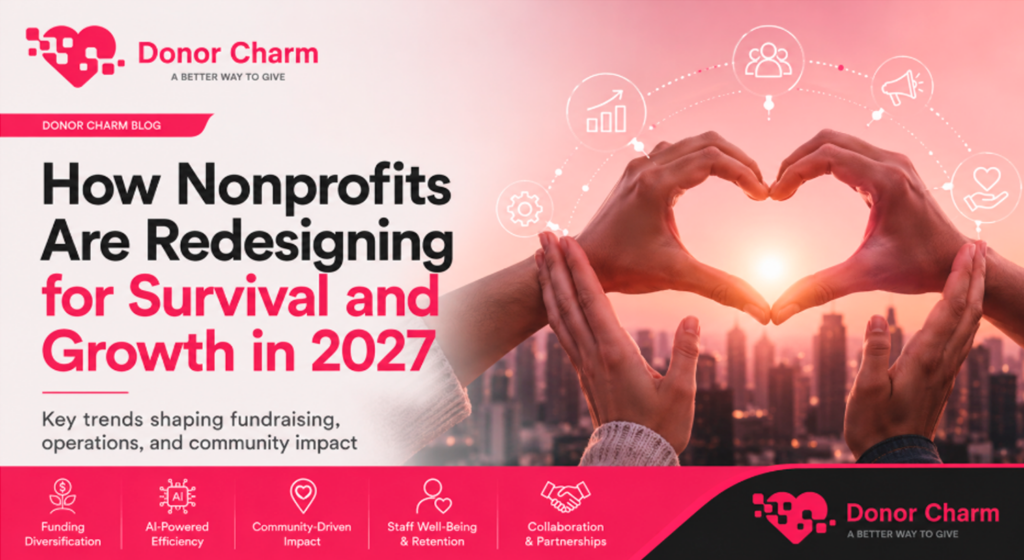
Here are the biggest nonprofit trends shaping 2027 — and why they matter.
1. Nonprofits Are Diversifying Revenue Streams More Aggressively Than Ever
For years, many nonprofits relied heavily on grants, annual fundraising campaigns, or a small group of major donors to sustain operations.
That model is becoming increasingly difficult to maintain.
With federal and state funding facing delays, increased scrutiny, and uncertainty, organizations are being forced to think more strategically about long-term financial sustainability.
In response, nonprofits are investing more heavily in:
- Major donor cultivation
- Planned giving programs
- Donor-Advised Fund (DAF) outreach
- Monthly recurring donor programs
- Corporate partnerships
- Mission-driven earned revenue opportunities
This shift represents more than just financial planning — it reflects a broader transformation in nonprofit fundraising strategy.
Donors today expect transparency, measurable impact, and meaningful engagement. Organizations that diversify their funding while strengthening donor relationships will be far more resilient moving into 2027 and beyond.
At Donor Charm, we’re seeing nonprofits prioritize donor retention and relationship management more intentionally than ever before because sustainable fundraising starts with long-term trust.
2. AI for Nonprofits Is Moving From Experimentation to Essential Infrastructure
Artificial intelligence is no longer a future conversation for nonprofits.
It’s already reshaping how organizations manage fundraising, communications, donor engagement, and internal operations.
The nonprofits growing most effectively right now are using AI tools to:
- Automate donor communication workflows
- Personalize donor journeys
- Analyze fundraising performance
- Improve donor retention strategies
- Draft campaign messaging
- Streamline administrative tasks
- Generate operational insights
The goal is not to replace human connection.
The goal is to give nonprofit teams more time to focus on the relationships and mission work that matter most.
One of the biggest challenges nonprofits continue to face is limited staff capacity. AI allows organizations to scale operational efficiency without dramatically increasing overhead costs.
As nonprofit technology continues evolving, organizations that embrace AI strategically will gain a significant advantage in donor engagement and operational sustainability.
3. Community-Driven Fundraising Is Becoming More Important
One of the most encouraging trends I’m seeing across the nonprofit sector is the return to community-centered engagement.
Donors increasingly want to feel personally connected to the organizations they support. They want to see local impact, hear authentic stories, and understand how their contributions directly affect the communities around them.
As a result, nonprofits are focusing more intentionally on:
- Local relationship-building
- Facility tours and in-person engagement
- Community advisory groups
- Grassroots partnerships
- Personalized donor communication
- Stakeholder involvement in program planning
This shift matters because donor retention is deeply connected to emotional trust and visibility.
The organizations building strong community ecosystems are creating more loyal donor bases and stronger long-term fundraising stability.
Technology helps scale communication, but authentic connection remains at the center of successful nonprofit fundraising.
4. Nonprofit Burnout Is Forcing Organizations to Rethink Operations
Burnout remains one of the most significant challenges facing nonprofit leaders and staff teams today.
For too long, many organizations operated under the assumption that passion alone could compensate for understaffing and operational strain.
That approach is no longer sustainable.
Nonprofits are increasingly recognizing that staff well-being directly impacts fundraising performance, program effectiveness, and long-term organizational growth.
To improve retention and operational stability, organizations are implementing:
- Flexible work schedules
- Hybrid work models
- Mental health support initiatives
- Fractional leadership roles
- Shared staffing partnerships
- Professional development investments
This operational redesign is becoming critical for organizations trying to maintain mission effectiveness while protecting team sustainability.
Healthy organizations build stronger missions.
5. Collaboration Is Replacing Competition Across the Nonprofit Sector
Another major shift shaping 2027 is the growing emphasis on collaboration over competition.
Nonprofits are increasingly exploring:
- Shared services
- Joint fundraising initiatives
- Strategic partnerships
- Community coalitions
- Purposeful mergers
- Shared operational infrastructure
Instead of duplicating efforts, organizations are recognizing the value of collective impact and shared capacity.
In many cases, collaboration is helping nonprofits reduce overhead costs while expanding mission reach more effectively than operating independently.
The future of nonprofit growth will likely belong to organizations willing to build strong partnerships instead of isolated systems.
The Future of Nonprofit Growth Will Belong to Adaptive Organizations
The nonprofit sector is entering a transformational era.
Organizations that continue relying on outdated fundraising models, disconnected donor communication, and unsustainable operational practices will face increasing pressure over the next several years.
But nonprofits willing to adapt have an incredible opportunity ahead of them.
The organizations leading the future of the sector are:
- Diversifying fundraising strategies
- Investing in donor retention
- Leveraging AI tools effectively
- Prioritizing community engagement
- Supporting staff sustainability
- Building collaborative partnerships
At Donor Charm, we believe nonprofit growth happens when organizations combine technology, strategy, and authentic human connection.
The nonprofits that thrive in 2027 won’t simply be the ones working harder.
They’ll be the ones building smarter systems for long-term impact.
About Donor Charm
Donor Charm helps nonprofits strengthen donor relationships, improve fundraising operations, and grow sustainable impact through smarter donor engagement strategies and nonprofit technology solutions.
Learn more about how Donor Charm supports nonprofit growth and donor retention strategies for organizations preparing for the future of fundraising.